
Videos & Animations
See how change ringing bells are rung.
Videos
- Why people enjoy change ringing A video produced by the Central Council of Church Bell Ringers. Watch on YouTube (opens in a new tab)
- Learning to ring A British video on learning to ring. Watch on YouTube (opens in a new tab)
- The WRS YouTube channel More videos from the Washington Ringing Society. Watch on YouTube (opens in a new tab)
Animations of change ringing bells being rung
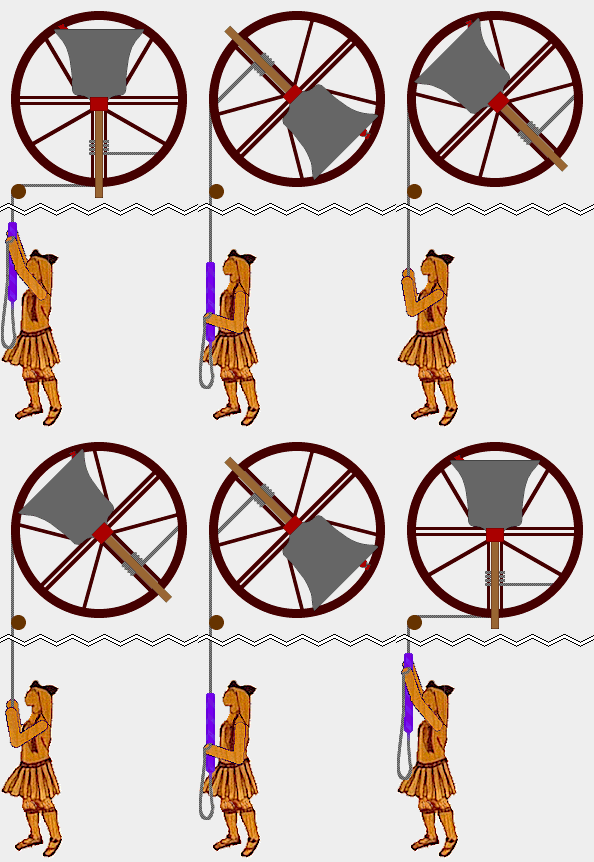
Full-circle ringing
Change ringing bells swing "full circle." When the ringer pulls the "sallie" (the fluffy segment of the rope) to start the bell from its initial "mouth up" position, that is called the "handstroke." After the bell rotates almost 360 degrees, the ringer pulls on the "tail" end of the rope and the bell swings back in the opposite direction: that is called the "backstroke." At either handstroke or backstroke, the bell sounds when the clapper strikes the leading edge of the bell. The time between strikes of the clapper can take about two seconds.
A special thanks to Barney Stratford for allowing us to use his image.

Dodging
In this image of two bells dodging with each other, first, the one on the left rings before the one on the right. Then the next time they each strike, the bell on the left strikes after the one on the right.

Mechanisms of a bell swinging
On the bottom of this image you can see the "stay" that's attached to the bell headstock. The image shows the stay moving the "slider," which is mounted on the frame. This mechanism keeps the bell from over-rotating.
The action of the rope as it goes around the wheel is also visible. At "backstroke," the rope is most of the way around the wheel. At "handstroke," the rope goes only part way around the wheel.
A special thanks to Chris Billinge for allowing us to use his image.

Rounds on five bells
These five ringers are pulling their bells in sequence from left to right, highest pitch to lowest pitch.
Please feel free to link to our animations with acknowledgment.